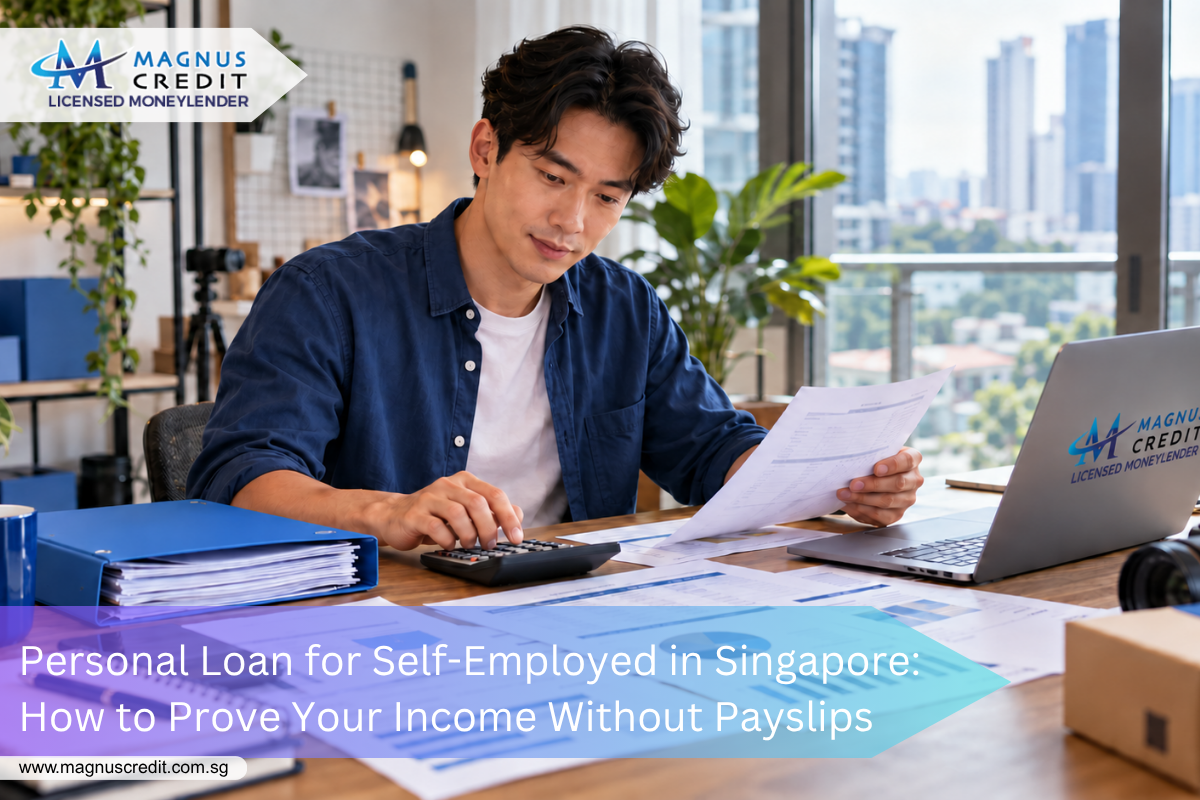
Being self-employed does not necessarily prevent you from applying for a personal loan. The main challenge is demonstrating your actual income when you do not receive conventional monthly payslips or regular employer CPF contributions.
Freelancers, sole proprietors, commission earners and platform workers often have income that changes from month to month. A lender therefore needs sufficient records to distinguish recurring earnings from one-off deposits, transfers and gross business revenue.
This practical guide explains how to prepare for a personal loan for self-employed applicants in Singapore, which documents can support your income and how to calculate a repayment amount that remains manageable during quieter months.
Who Is Considered Self-Employed?
A self-employed person earns income through a trade, business, profession or service rather than receiving a fixed salary from an employer.
This can include:
- Freelancers
- Sole proprietors
- Consultants
- Property or insurance agents
- Commission-based sales representatives
- Private-hire drivers
- Delivery riders
- Online sellers
- Home-based business owners
- Hawkers and food-stall operators
- Tutors and trainers
- Designers, photographers and content creators
- Tradespeople and technicians
- Professionals operating their own practices
- Partners in small businesses
The documents required will depend on how you earn and receive your income.
A Grab driver, freelance designer and sole proprietor may all be self-employed, but their financial records will look very different.
Can Self-Employed Individuals Apply for a Personal Loan?
Yes. Self-employed individuals may apply for a personal loan in Singapore, subject to the lender’s assessment and applicable borrowing limits.
A lender may consider:
- Average monthly income
- Consistency of earnings
- Length of self-employment
- Recent business activity
- Existing loan obligations
- Repayment history
- Essential household expenses
- Business operating costs
- Number of dependants
- Requested loan amount
- Proposed repayment schedule
Approval is not guaranteed simply because an applicant meets the legal borrowing limit. The lender must still determine whether the proposed repayments are affordable.
The Self-Employed Income-Proof Toolkit
You do not necessarily need every document below. However, combining several reliable records can create a clearer picture of your financial position.
1. IRAS Notice of Assessment
Your Notice of Assessment provides independent evidence of income declared for tax purposes.
It may help show:
- Assessed income
- Relevant Year of Assessment
- Declared trade or professional income
- Tax position
An older Notice of Assessment may not reflect recent changes in your earnings. If your income has increased or decreased significantly, provide more recent bank statements, invoices and payment records as well.
2. Personal bank statements
Bank statements help demonstrate the income you actually receive.
A lender may examine:
- Frequency of deposits
- Source of payments
- Average monthly inflow
- Existing loan deductions
- Returned payments
- Regular household expenditure
- Transfers between your own accounts
- Balance remaining after expenses
Several consecutive months normally provide a more meaningful picture than a single strong month.
3. Business bank statements
If you operate a business account, prepare statements showing:
- Customer receipts
- Regular operating expenses
- Supplier payments
- Rental costs
- Payroll expenses
- Owner withdrawals
- General cash-flow patterns
Keeping business and personal transactions separate makes it easier to identify your genuine earnings.
4. ACRA business profile
An ACRA business profile may confirm:
- Registered business name
- Business structure
- Registration status
- Principal activities
- Commencement date
- Owners, partners or directors
- Registered business address
An ACRA record shows that the business exists, but it does not by itself prove how much income the applicant earns.
5. Invoices and receipts
Freelancers and service providers can use invoices to connect customer payments with deposits appearing in their bank accounts.
Useful records include:
- Issued invoices
- Customer receipts
- Completed project records
- Service agreements
- Retainer agreements
- Electronic payment confirmations
- Marketplace sales statements
Where possible, invoice amounts and payment dates should correspond with deposits in your bank statements.
6. Platform earnings statements
Private-hire drivers, delivery riders and other platform workers can prepare statements showing:
- Completed jobs
- Gross earnings
- Platform commissions
- Incentive payments
- Vehicle-related deductions
- Weekly payouts
- Net earnings transferred
Applicants earning through Grab or Gojek can also review Magnus Credit’s Grab and Gojek driver loan information.
7. Commission statements
Property agents, insurance representatives and other commission earners may submit:
- Commission statements
- Transaction records
- Agency payment records
- Bank statements showing corresponding deposits
- Annual tax records
Because commission income can fluctuate significantly, prepare records covering both strong and weaker months.
8. Contracts and recurring customer agreements
A contract does not prove that payment has already been received, but it may demonstrate an ongoing source of future income.
Examples include:
- Monthly service retainers
- Long-term freelance contracts
- Maintenance agreements
- Confirmed purchase orders
- Tenancy-related service agreements
- Recurring customer subscriptions
Support contracts with bank deposits or payment records wherever possible.
Document Checklist by Type of Work
| Type of applicant | Recommended supporting documents |
|---|---|
| Freelancer | Invoices, client contracts, bank statements and IRAS Notice of Assessment |
| Sole proprietor | ACRA profile, business and personal bank statements, tax records and invoices |
| Private-hire driver | Platform earnings statements, bank statements, identification and proof of address |
| Delivery rider | Platform payout history, bank statements and recent income summary |
| Commission earner | Commission statements, bank deposits, agency records and tax documents |
| Online seller | Marketplace sales reports, payment-gateway statements, bank records and ACRA profile |
| Hawker or food operator | Business records, bank statements, supplier invoices and tax assessment |
| Home-based business owner | Sales records, invoices, bank statements and registration documents where applicable |
| Consultant | Client agreements, issued invoices, bank deposits and Notice of Assessment |
Magnus Credit’s eligibility page provides the general documents applicants should prepare.
Can You Apply Without Payslips?
A self-employed applicant may not receive payslips. That does not automatically prevent an application, but alternative income evidence will normally be required.
Suitable records can include:
- IRAS Notice of Assessment
- Bank statements
- Invoices and receipts
- Platform earnings reports
- Commission statements
- Customer contracts
- ACRA business profile
- Business accounts
A responsible lender cannot determine affordability using only the applicant’s verbal estimate of income.
Be cautious if someone advertises a “loan without payslip or documents” and promises guaranteed approval. Licensed moneylenders must conduct proper checks before granting a loan.
Gross Revenue Is Not Personal Income
One of the most common mistakes self-employed applicants make is presenting total business revenue as personal income.
Gross revenue is the total amount the business receives before paying its expenses. It does not necessarily represent the amount available for personal spending or loan repayment.
Consider this simplified example:
| Monthly business activity | Amount |
|---|---|
| Customer receipts | S$8,500 |
| Materials and inventory | −S$2,300 |
| Rental and utilities | −S$1,200 |
| Platform and payment fees | −S$550 |
| Transport and delivery | −S$600 |
| Other operating expenses | −S$750 |
| Amount remaining before personal commitments | S$3,100 |
In this example, the business receives S$8,500, but only S$3,100 remains before the owner’s household expenses and existing repayments.
Applying based on S$8,500 could result in an unaffordable repayment schedule.
How Is Irregular Income Assessed?
When income varies, using only the highest-earning month can produce an unrealistic picture.
A lender may review several months and calculate a reasonable average.
Six-month income example
| Month | Net income received |
|---|---|
| January | S$3,400 |
| February | S$2,300 |
| March | S$3,100 |
| April | S$2,650 |
| May | S$3,550 |
| June | S$2,800 |
| Total | S$17,800 |
| Monthly average | Approximately S$2,967 |
However, an average does not show the entire risk.
In this example, the applicant’s lowest month was S$2,300. A repayment that is comfortable when earning S$3,550 might be difficult during a S$2,300 month.
A safer affordability check should therefore consider:
- Average monthly income
- Lowest recent monthly income
- Essential living expenses
- Business operating costs
- Existing repayments
- Emergency savings
A Practical Affordability Test
Before applying, calculate how much remains during a conservative income month.
For example:
| Monthly cash flow | Amount |
|---|---|
| Conservative net income | S$2,500 |
| Housing and utilities | −S$850 |
| Food and transport | −S$600 |
| Insurance and medical costs | −S$200 |
| Family commitments | −S$250 |
| Existing repayments | −S$250 |
| Business reserve | −S$150 |
| Remaining amount | S$200 |
A new instalment substantially exceeding S$200 would create immediate pressure in a weaker month.
Do not determine affordability using only your best-performing month or an expected future contract that has not started paying.
How Much Can a Self-Employed Person Borrow?
The maximum unsecured borrowing limit across all licensed moneylenders depends on annual income and residency status.
| Annual income | Singapore citizens and PRs | Foreigners residing in Singapore |
|---|---|---|
| Less than S$10,000 | S$3,000 | S$500 |
| S$10,000 to below S$20,000 | S$3,000 | S$3,000 |
| S$20,000 and above | Up to six times monthly income | Up to six times monthly income |
These limits apply to the total outstanding unsecured amount across all licensed moneylenders—not separately to every lender.
The statutory maximum is not a guaranteed approval amount. A lender may approve less after considering the applicant’s verified income, business expenses, existing debts and ability to repay.
Read Magnus Credit’s guide to licensed moneylender loan limits in Singapore for more examples.
Personal Loan or Business Loan: Which Should You Consider?
The correct option depends on the business structure, use of funds and party responsible for repayment.
| Personal loan | Business loan |
|---|---|
| Borrower is an individual | Borrower may be a company or business owner |
| Commonly used for personal or household needs | Intended for business-related expenses |
| Assessed using personal income and commitments | Assessment may include company cash flow and financial accounts |
| Usually unsecured | Structure depends on the facility |
| Individual signs the contract | Company representatives or guarantors may need to sign |
A sole proprietor and the business are not separate legal entities in the same way as a private limited company.
For funding related to inventory, equipment, payroll or working capital, review Magnus Credit’s business loan options.
Do not misrepresent the intended use of the loan or provide inaccurate business records.
Why Self-Employed Applications Get Delayed
Income cannot be traced
Cash deposits without invoices, sales records or customer information can be difficult to verify.
Only the strongest month is submitted
One high-earning month does not demonstrate recurring income.
Business and personal transactions are mixed
A single account containing sales, household spending, transfers and borrowed funds may not clearly show genuine earnings.
Revenue is presented without expenses
Total sales do not demonstrate how much money remains after operating costs.
Records are outdated
An old tax assessment or inactive business profile may not reflect current circumstances.
Transfers are counted as income
Moving money between your own accounts does not create new earnings.
Existing commitments are omitted
Undisclosed repayments can make an otherwise affordable-looking application inaccurate.
Requested amount is too high
The legal maximum may be larger than the amount an applicant can comfortably repay.
How to Strengthen Your Application
Approval cannot be guaranteed, but clear documentation can make your circumstances easier to assess.
Maintain a dedicated business account
Where practical, receive customer payments and pay operating expenses through a separate account.
Issue proper invoices
Include the invoice date, service or product, amount and payment terms. Keep evidence when payment is received.
Prepare several consecutive months of records
A longer period provides a more balanced view of variable income.
Explain unusual transactions
If a large deposit came from selling equipment or transferring savings, identify it accurately instead of presenting it as recurring income.
Declare all existing repayments
Include licensed moneylender loans, bank loans, credit cards, vehicle financing and other regular commitments.
Apply for the amount actually required
Calculate the expense you need to cover instead of automatically requesting the maximum available amount.
Plan using a conservative income month
Your repayment should remain manageable when business is slower than usual.
Keep your tax records current
Up-to-date declarations make it easier to demonstrate legitimate income.
Interest and Permitted Fees
Licensed moneylenders in Singapore may charge:
- Interest of up to 4% per month
- Late interest of up to 4% per month on the overdue amount
- An administrative fee of up to 10% of the loan principal when the loan is granted
- A late fee of up to S$60 for each month of late repayment
- Court-ordered legal costs following a successful recovery claim
Regular interest must be calculated using the outstanding principal after principal repayments have been deducted.
Before accepting an offer, request a written breakdown showing:
- Principal amount
- Administrative fee
- Net amount disbursed
- Monthly interest rate
- Number of instalments
- Instalment amount
- Total repayment amount
- Late-payment consequences
How to Apply Safely
Confirm that the lender’s name, website and approved business address appear on the Registry of Moneylenders’ official list.
Licensed moneylenders cannot solicit borrowers through SMS, telephone calls or social-media messages. They must also conduct face-to-face identity verification at their approved business premises before granting a loan. A loan transaction completed entirely online is not permitted.
Be cautious if someone:
- Guarantees approval before assessment
- Sends an unsolicited WhatsApp loan offer
- Requests payment before disbursement
- Asks for your Singpass password
- Requests your online banking credentials or OTP
- Offers to complete the transaction entirely online
- Asks you to sign an incomplete agreement
- Refuses to explain the interest and fees
- Uses an address different from the official registry
Applicants may begin through Magnus Credit’s online application page, but approval remains subject to assessment, document verification and the required in-person process.
Frequently Asked Questions
Can a freelancer apply for a personal loan in Singapore?
Yes, subject to assessment. A freelancer may use bank statements, invoices, customer contracts and tax records to demonstrate income.
Can I apply without monthly payslips?
You may apply if you genuinely do not receive payslips, but you will normally need alternative proof of income.
Are CPF contributions compulsory for self-employed applicants?
Self-employed individuals may not receive employer CPF contributions. Other records, such as tax assessments, bank statements and invoices, may be used for assessment.
How many months of bank statements should I prepare?
Requirements differ according to the applicant. Preparing at least several consecutive recent months can help demonstrate normal income patterns.
Can a new business owner apply?
A new business owner may apply, but a short operating history can make recurring income more difficult to establish. Additional records may be requested.
Can private-hire drivers apply without payslips?
Platform earnings reports and corresponding bank deposits may be used to demonstrate ride-hailing income. Review Magnus Credit’s dedicated Grab and Gojek loan information before applying.
Is an ACRA business profile enough?
No. It confirms business registration but does not prove current income or repayment capacity.
Does high business revenue guarantee approval?
No. Operating expenses, personal commitments, existing debts and the proposed repayment amount must also be considered.
Will a bank rejection automatically disqualify me?
Not necessarily. Licensed moneylenders conduct their own assessments. However, approval is never guaranteed.
Can I complete the whole application online?
No. An application may begin online, but identity verification must be completed face-to-face at the lender’s approved business premises before a loan is granted.
Final Thoughts
Applying for a personal loan for self-employed individuals in Singapore is possible even when you do not receive conventional monthly payslips.
The key is to demonstrate your earnings using reliable and consistent records. Depending on your occupation, these may include bank statements, invoices, tax assessments, platform earnings reports, commission statements and business documents.
Use net income rather than gross sales when evaluating affordability. Base the repayment on a conservative month, disclose existing commitments and borrow only what you can realistically repay.
Review Magnus Credit’s personal loan information, check the eligibility requirements or contact Magnus Credit if you need clarification about suitable supporting documents.
This article is for general educational purposes and does not constitute financial advice. Every loan application is subject to assessment, verification and approval.