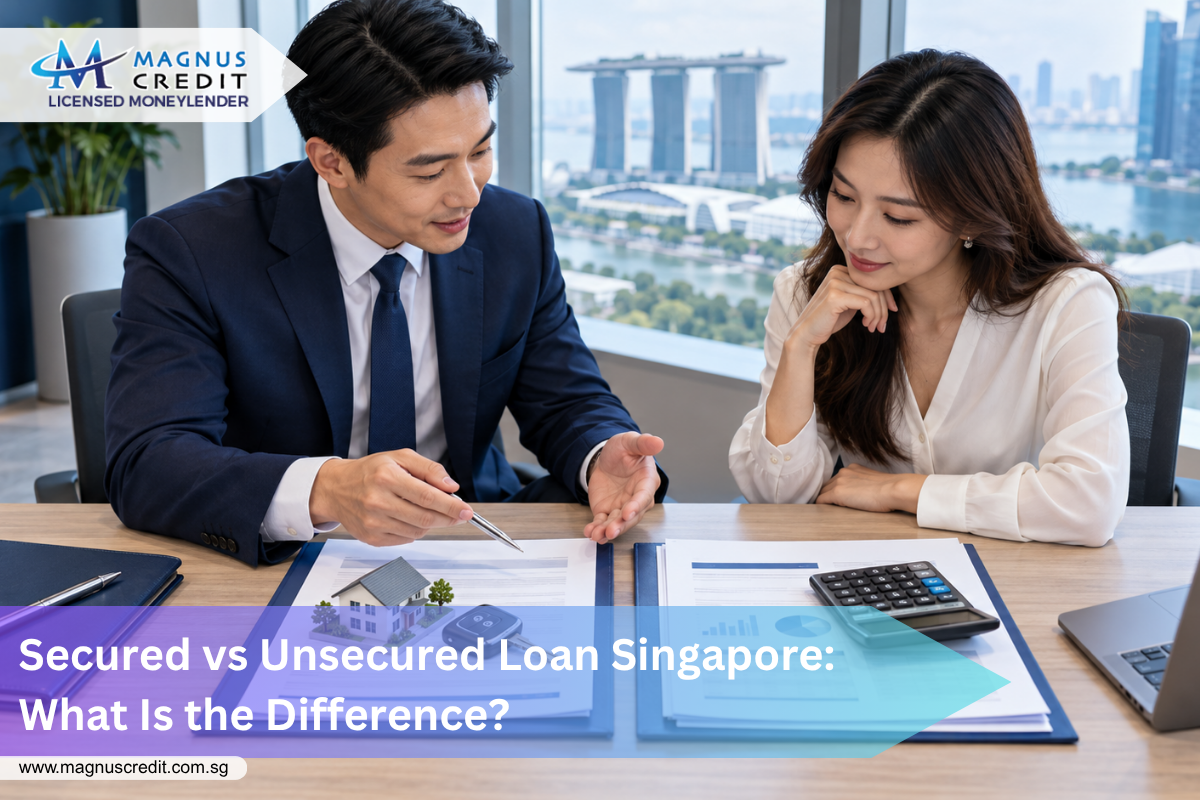
The main difference between a secured loan and an unsecured loan is collateral.
A secured loan is supported by an asset or security arrangement. An unsecured loan does not require the borrower to pledge a specific asset, so assessment relies more heavily on income, existing debts and repayment capacity.
When comparing a secured vs unsecured loan in Singapore, do not consider only the amount available. You should also examine the risk to your assets, repayment period, total borrowing cost and consequences of default.
This guide explains how both loan types work and what to check before signing an agreement with a licensed moneylender.
Quick Comparison
| Feature | Secured loan | Unsecured loan |
|---|---|---|
| Collateral | Required | Usually not required |
| Main basis of assessment | Collateral value and repayment capacity | Income, existing commitments and repayment history |
| Legal borrowing limit | No prescribed income-based maximum | Income-based limits apply across licensed moneylenders |
| Risk to an asset | Asset or secured interest may be affected following default | No specific pledged asset, although the debt remains legally recoverable |
| Common uses | Larger or asset-supported financing | Personal expenses and short-term financial needs |
| Cooling-off period | Does not apply | Applies to eligible unsecured non-business loans |
| Approval | Subject to valuation, documents and assessment | Subject to income, documents and affordability |
| Repayment obligation | Contractually binding | Contractually binding |
Neither option is automatically better. The more suitable structure depends on the borrower’s purpose, assets, financial commitments and ability to repay.
What Is a Secured Loan?
A secured loan is financing backed by an asset or another form of security.
Depending on the agreement, security might involve:
- Real estate
- A vehicle
- Business equipment
- Another asset accepted by the lender
- A contractual right connected to sale proceeds
The asset does not automatically become the lender’s property when the loan is granted. However, default may allow the lender to exercise rights under the security agreement, subject to the contract and applicable law.
Borrowers should understand exactly:
- Which asset is being used
- How it has been valued
- What rights are granted to the lender
- What happens after a missed payment
- How the security is released after full repayment
- Whether legal or valuation expenses apply
Obtain independent legal advice if you do not understand a security or property-related clause.
What Is an Unsecured Loan?
An unsecured loan does not require a specific asset to be pledged as collateral.
The lender commonly assesses:
- Verifiable income
- Employment or business stability
- Existing licensed moneylender loans
- Repayment history
- Household expenses
- Financial dependants
- Amount requested
- Proposed repayment period
- Ability to manage the instalments
Examples may include:
- Personal loans
- Payday loans
- Foreigner loans
- Certain debt-consolidation arrangements
- Other unsecured consumer loans
Unsecured does not mean there is no legal obligation to repay. The loan agreement remains binding, and late-payment charges or recovery action may apply when a borrower fails to follow the contract.
How Much Can You Borrow?
Secured loans
The Ministry of Law’s borrower guidance states that secured loans do not have the same prescribed borrowing ceiling as unsecured loans.
However, this does not mean a borrower can automatically obtain any amount.
The approved amount may depend on:
- Value and type of collateral
- Existing claims over the asset
- Income
- Repayment capacity
- Loan purpose
- Lender’s assessment
- Applicable legal documentation
Unsecured loans
Income-based borrowing limits apply to the borrower’s combined unsecured borrowing across all licensed moneylenders.
| Annual income | Singapore citizens and PRs | Foreigners residing in Singapore |
|---|---|---|
| Below S$10,000 | S$3,000 | S$500 |
| S$10,000 to below S$20,000 | S$3,000 | S$3,000 |
| S$20,000 and above | Up to six times monthly income | Up to six times monthly income |
These figures are legal maximums, not guaranteed approval amounts.
For example, a Singapore citizen earning S$3,500 per month may have a statutory aggregate ceiling of up to S$21,000 if annual income is at least S$20,000.
If that person already owes S$8,000 across licensed moneylenders, the remaining statutory capacity may be up to S$13,000. The lender can still approve less—or decline the application—after assessing affordability.
Read Magnus Credit’s guide to licensed moneylender loan limits in Singapore for more examples.
Does a Secured Loan Have a Lower Interest Rate?
A secured loan may sometimes be offered on different terms because collateral can reduce part of the lender’s risk. However, a lower rate should never be assumed.
The actual offer may depend on:
- Collateral value
- Type and condition of the asset
- Loan amount
- Repayment period
- Borrower’s income
- Existing obligations
- Legal and valuation requirements
- Lender’s assessment
Compare the complete offer rather than the headline rate.
Ask for:
- Monthly interest rate
- Administrative fee
- Amount disbursed
- Repayment schedule
- Total interest
- Total repayment
- Valuation or legal costs
- Consequences of default
- Early-settlement procedure
- Procedure for releasing the security
What Interest and Fees Can a Licensed Moneylender Charge?
The maximum regular interest rate is 4% per month. This cap applies regardless of the borrower’s income and whether the loan is secured or unsecured.
Interest must be calculated using the outstanding principal after repayments allocated to principal have been deducted.
Other permitted limits include:
- Administrative fee of up to 10% of the principal when the loan is granted
- Late interest of up to 4% per month on the overdue amount
- Late fee of up to S$60 for each month of late repayment
- Court-ordered legal costs for a successful recovery claim
Regular interest, late interest, the administrative fee and late fees combined cannot exceed an amount equivalent to the original principal.
These are statutory maximums. Your actual interest, fees and total repayment should be stated in the loan contract.
How Does Collateral Change the Risk?
Collateral provides additional security for the lender, but it creates additional risk for the borrower.
Suppose a borrower secures a loan using an asset essential to their livelihood. Losing access to that asset following default could affect both income and the ability to repay other commitments.
Before providing collateral, ask:
- Is this asset essential for my work or family?
- Is the proposed loan substantially smaller than the asset’s value?
- What happens after one missed payment?
- Is there a grace or notification process?
- Can the lender lodge a caveat or other interest?
- Can I sell or refinance the asset during the loan?
- How is the security removed after settlement?
- What documentation confirms its release?
Do not pledge an asset merely to obtain a larger amount than you genuinely need.
Property Caveats and Loan Agreements
Some secured arrangements may include terms allowing a lender to lodge a caveat over sale proceeds from real estate after default.
The Ministry of Law advises borrowers to consider these clauses carefully. When a caveat is lodged, the property may not be sold without first resolving the lender’s claim. Repayment from the net sale proceeds could consume a substantial part of those proceeds.
If a loan agreement contains a property-related clause:
- Read the complete clause.
- Ask when the caveat can be lodged.
- Confirm what amount it may secure.
- Ask how it will be withdrawn after settlement.
- Consider obtaining independent legal advice.
Which Loans Qualify for the Cooling-Off Period?
From 15 September 2026, eligible unsecured loans other than business loans receive a three-business-day cooling-off period.
The period:
- Begins after the date of disbursement
- Excludes the disbursement date
- Excludes Saturdays
- Excludes Sundays
- Excludes Singapore public holidays
Secured loans are not covered by this cooling-off framework. Business loans are also excluded.
For an eligible cancellation, the borrower returns the remaining amount disbursed and up to the permitted portion of the loan-approval fee. No interest is charged for a qualifying cancellation, and the total amount repaid cannot exceed the principal.
Read Magnus Credit’s cooling-off period guide before relying on this protection.
Secured Loan Advantages and Risks
Potential advantages
- May support a larger financing requirement
- Assessment can consider an eligible asset
- May offer different repayment terms
- Can be considered when unsecured limits are insufficient
- May suit a defined asset-backed funding purpose
Important risks
- The secured asset may be at risk after default
- Valuation and documentation may take additional time
- Legal or asset-related costs may apply
- The borrower may have restrictions involving the asset
- A property caveat could affect a future sale
- Borrowing against a high-value asset for a small expense may be disproportionate
Unsecured Loan Advantages and Risks
Potential advantages
- No specific asset needs to be pledged
- Documentation may be more straightforward
- Suitable for smaller or short-term personal requirements
- Borrowing limits are transparent
- Eligible consumer loans receive the cooling-off protection
Important risks
- Approval depends heavily on repayment capacity
- The amount available may be limited by income
- Late interest and fees may apply after missed payments
- The debt remains legally enforceable
- Taking several unsecured loans can strain monthly cash flow
- Borrowers may be tempted to borrow again when repayment becomes difficult
When Might a Secured Loan Be Considered?
A secured loan might be considered when:
- The required amount exceeds the borrower’s unsecured limit.
- The borrower has an appropriate asset.
- The funding need is clearly defined.
- Repayment is supported by reliable income.
- The borrower understands the consequences of default.
- The asset’s use as collateral is proportionate to the borrowing need.
- Independent advice has been obtained where necessary.
It should not be used simply to maximise the amount available.
When Might an Unsecured Loan Be Considered?
An unsecured loan might be considered when:
- The required amount is relatively modest.
- The borrower does not want to pledge an asset.
- Income can support the proposed instalments.
- The expense is necessary and clearly calculated.
- The repayment period is manageable.
- Existing unsecured borrowing remains within the legal limit.
- The borrower retains sufficient money for essential expenses.
Magnus Credit provides information about its personal loan in Singapore for eligible applicants seeking unsecured financing.
Secured Versus Unsecured Loan Example
Consider a borrower who needs S$8,000 for an essential expense.
Option A: Unsecured loan
The borrower:
- Does not pledge an asset
- Is assessed using income and existing obligations
- Must remain within the aggregate unsecured borrowing limit
- Receives a stated repayment schedule
- May qualify for the cooling-off period if all conditions are met
Option B: Secured loan
The borrower:
- Provides an accepted asset or security
- Must understand the lender’s rights over that security
- Is not subject to the same prescribed unsecured borrowing ceiling
- May need valuation or additional documents
- Does not receive the unsecured-loan cooling-off protection
The correct decision cannot be determined using the amount alone. The borrower must compare total cost, asset risk and repayment affordability.
Questions to Ask Before Choosing
Ask the lender:
- Is this loan secured or unsecured?
- If secured, what asset supports the loan?
- How was the asset valued?
- What rights does the lender receive?
- What happens if one instalment is late?
- What is the principal?
- How much will I receive?
- What interest rate applies?
- What fees apply?
- What is the total repayment?
- Does the cooling-off period apply?
- What happens to the security after full repayment?
- How do I obtain written confirmation of closure?
- Can I settle the loan early?
- Are there legal, valuation or administrative costs?
Do not proceed until every material term has been explained clearly.
Magnus Credit’s loan-contract checklist provides additional questions to review before signing.
Documents That May Be Required
For an unsecured loan
Documents may include:
- NRIC or passport
- Valid work pass for foreign applicants
- Proof of address
- Payslips
- CPF contribution history
- IRAS Notice of Assessment
- Bank statements
- Evidence of existing obligations
For a secured loan
In addition to income and identification documents, the lender may request:
- Evidence of asset ownership
- Valuation documents
- Existing financing statements
- Insurance details
- Property or vehicle records
- Information about existing charges over the asset
- Relevant legal documentation
Requirements depend on the proposed security and individual circumstances.
How to Apply Safely
Verify that the lender appears on the Ministry of Law’s official Registry of Moneylenders list.
Check that:
- The company name matches.
- The business address matches.
- The website domain matches.
- The official contact information matches.
- Identity verification occurs at the approved office.
- The complete contract is explained before signing.
- You receive a copy of the agreement.
Licensed moneylenders may advertise only through their own websites, business or consumer directories, and advertisements at their approved premises.
Unsolicited loan promotions sent through WhatsApp, SMS, calls or social media should not be trusted. Scammers may imitate genuine licensed companies and request advance transfers described as GST or processing fees.
Frequently Asked Questions
What is the main difference between secured and unsecured loans?
A secured loan is backed by collateral or another security arrangement. An unsecured loan does not require a specific asset to be pledged.
Is a personal loan secured or unsecured?
Most personal loans from licensed moneylenders are unsecured, but the actual structure depends on the contract. Confirm this before signing.
Can I borrow more with a secured loan?
Secured loans are not subject to the prescribed income-based unsecured borrowing limits. However, the amount offered still depends on the collateral, documents and lender’s assessment.
What happens to collateral if I miss a payment?
The consequences depend on the security agreement and applicable law. Review the default provisions and obtain legal advice if the terms are unclear.
Is the interest rate lower for a secured loan?
It may be offered on different terms, but a lower rate is not guaranteed. Compare the exact interest, fees, legal costs and total repayment.
What is the maximum interest rate?
Licensed moneylenders may charge regular interest of up to 4% per month on the outstanding principal. This applies to both secured and unsecured loans.
Does the cooling-off period apply to secured loans?
No. The three-business-day cooling-off period applies to eligible unsecured loans other than business loans.
Do unsecured loans require a guarantor?
Not necessarily. Whether a guarantor or surety is required depends on the lender, application and loan structure.
Is an unsecured loan risk-free because there is no collateral?
No. The debt is legally enforceable, and late charges or recovery action may result from default.
Which loan is better?
Neither is universally better. The suitable option depends on the amount required, assets, total cost, loan purpose and repayment capacity.
Final Thoughts
When comparing a secured vs unsecured loan in Singapore, begin with risk—not only the amount available.
An unsecured loan does not place a specific pledged asset at risk, but it is subject to income-based borrowing limits. A secured loan may support a different borrowing requirement, but the borrower must understand what could happen to the collateral following default.
Review the complete cost, repayment schedule, security terms and consequences of late payment before signing.
Magnus Credit Pte Ltd provides loan assessments subject to documentation, verification and repayment capacity. Review the available loan services or contact Magnus Credit for clarification about a proposed loan structure.
For an overview of regulated borrowing and available services, visit the Magnus Credit homepage for information about licensed money lenders in Singapore.
This article provides general educational information and does not constitute financial or legal advice. Loan terms, security arrangements and approval are subject to individual assessment, applicable law and the signed contract.