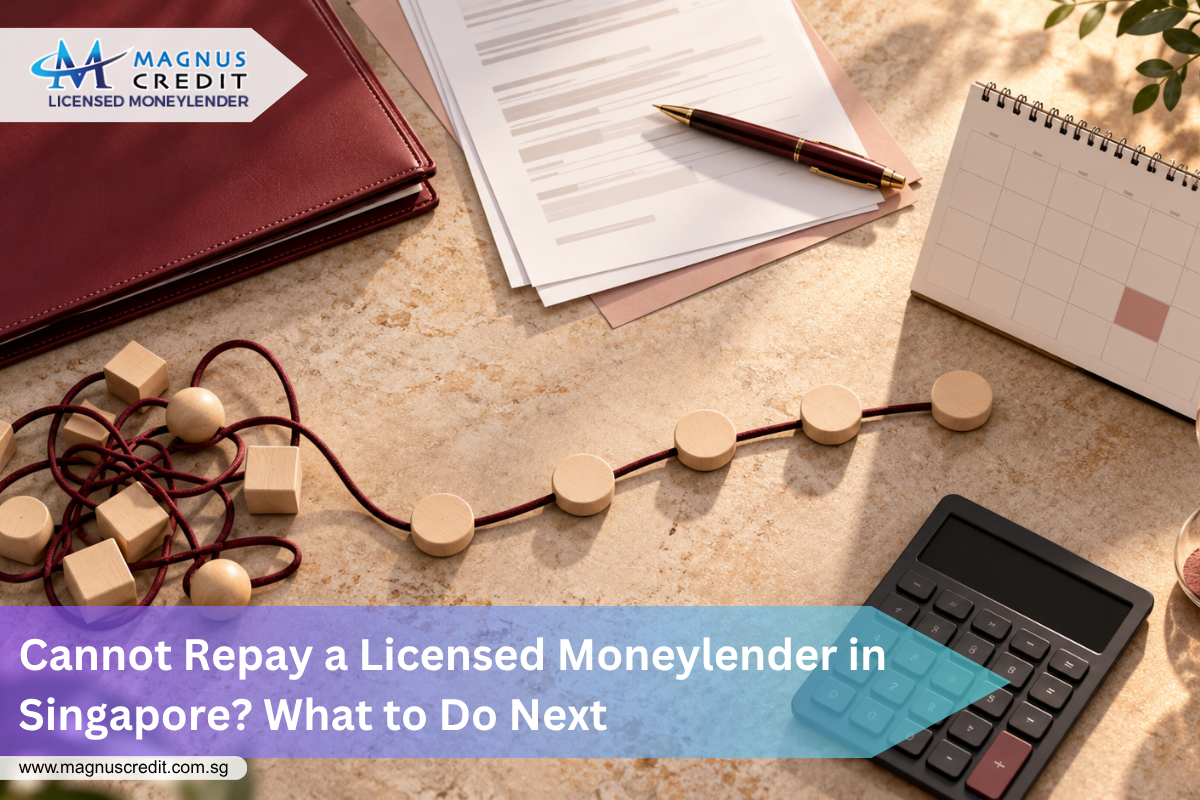
Missing a loan repayment can be stressful, but ignoring the situation will usually make it more difficult to resolve.
If you cannot repay a licensed moneylender in Singapore on time, contact the lender as early as possible. Ask for an updated account statement, understand the charges that may apply and discuss whether a manageable repayment arrangement is available.
This guide explains what may happen after a missed payment, the limits placed on late charges, the documents you should request and where to seek independent help when your financial difficulties involve several debts.
Key Takeaways
- Contact your lender before the payment date whenever possible.
- Do not avoid calls, letters or official payment reminders.
- Request an updated statement showing your outstanding principal, interest, fees and payments.
- Late interest may be charged only on the amount that is overdue.
- A licensed moneylender may charge a late fee of up to S$60 for each month of late repayment.
- Do not borrow repeatedly just to meet existing instalments.
- Never pay an unlicensed debt collector or unknown person without verifying their authority.
- Seek independent debt advice if several repayments have become unmanageable.
What Should You Do If You Cannot Make Your Next Payment?
Take action as soon as you realise that your income will not cover the upcoming instalment.
1. Review the repayment date and amount
Check your loan contract, repayment schedule and latest receipt. Confirm:
- The payment due date
- The instalment amount
- Your remaining principal
- The approved payment method
- The contractual consequences of late repayment
- The lender’s official contact details
Do not rely only on a WhatsApp message or verbal reminder. Refer to the documents issued when the loan was granted.
2. Calculate how much you can realistically pay
Review your available income after essential expenses such as:
- Housing
- Food
- Utilities
- Transport
- Medical needs
- Childcare
- Existing debt repayments
Avoid promising a repayment amount that you are unlikely to maintain. A realistic proposal is more useful than agreeing to an instalment that will create another default.
3. Contact the licensed moneylender promptly
Explain the situation clearly and provide accurate information.
You may need to describe:
- Why your income has changed
- Whether the problem is temporary or continuing
- When you expect to receive your next income
- How much you can presently afford
- Which other financial commitments you have
Any adjustment remains subject to the lender’s review and agreement. A borrower cannot change the repayment schedule unilaterally.
4. Obtain any arrangement in writing
If the lender agrees to a revised payment arrangement, request written confirmation.
The document should show:
- Revised payment amounts
- New payment dates
- Applicable interest and fees
- Remaining principal
- Total amount payable
- Consequences of missing the revised payments
Do not assume a telephone conversation has changed the original contract.
What Happens When a Licensed Moneylender Payment Is Late?
The consequences depend on your contract, the overdue amount and the length of the delay.
Possible consequences include:
- Late interest on the overdue amount
- A permitted monthly late fee
- Payment reminders
- Collection activity
- A negative repayment record
- Formal recovery proceedings
- Court-ordered costs if legal action succeeds
A missed payment does not make harassment, threats or violence lawful. Licensed moneylenders and their debt collectors must still comply with Singapore law.
How Much Late Interest Can Be Charged?
Licensed moneylenders may charge late interest of up to 4% per month.
Importantly, late interest may be calculated only on the amount that is overdue. It should not automatically be applied to portions of the loan that have not yet become due.
For example, assume:
- Monthly instalment due: S$500
- Amount unpaid: S$500
- Maximum late-interest rate: 4% per month
One month of late interest on the overdue instalment would be S$20.
This is a simplified illustration. The actual calculation depends on the contract, payment dates and outstanding amounts.
The Ministry of Law also states that a licensed moneylender may impose a late fee of up to S$60 for each month of late repayment. Review the current rules in the official guide to borrowing from licensed moneylenders.
Is There a Limit on Total Loan Charges?
Yes. The total of the following charges cannot exceed an amount equivalent to the original loan principal:
- Regular interest
- Late interest
- Administrative fee
- Late fees
Suppose the original principal is S$4,000. The combined interest and permitted fees cannot exceed S$4,000.
This does not remove the borrower’s responsibility to repay the original principal. Court-ordered legal costs may also be treated separately.
Ask the lender for a detailed statement if you do not understand how your outstanding balance was calculated.
What Information Should an Account Statement Show?
An updated statement can help you understand the debt and identify any payment that has not been recorded correctly.
Request a breakdown showing:
- Original loan principal
- Amount disbursed
- Administrative fee
- Contractual interest charged
- Principal already repaid
- Current outstanding principal
- Overdue instalments
- Late interest
- Late fees
- Payments received
- Current total outstanding amount
Keep every receipt, bank-transfer record and written exchange with the lender.
Licensed moneylenders should issue a receipt whenever a repayment is made. Check that the lender’s name, amount, date and remaining balance are recorded correctly.
Can You Request a Revised Repayment Plan?
You may ask the lender whether a revised arrangement is possible, but approval is not guaranteed.
A lender may consider:
- Your present income
- Reason for the payment difficulty
- Existing overdue amount
- Previous repayment history
- Other financial obligations
- Whether the proposed amount is sustainable
- Supporting documents
Supporting documents may include:
- Recent payslips
- Bank statements
- CPF contribution history
- Termination or retrenchment letter
- Medical documentation
- Evidence of reduced working hours
- Updated employment contract
- Records of other debts
Be honest about your financial position. Hiding other debts may result in an arrangement that you still cannot afford.
What Should You Avoid Doing?
Do not take another loan automatically
Borrowing again to pay an existing instalment can create a debt cycle. The new loan introduces another payment date, additional interest and possibly an administrative fee.
Consider another loan only after reviewing the full cost and confirming that it improves—not worsens—your overall financial position.
Do not ignore the lender
Avoiding communication does not stop interest, late charges or recovery action. Early contact usually provides more options than waiting until several payments have been missed.
Do not make payments to an unverified account
Before transferring money, confirm that the account belongs to the licensed moneylender or an officially authorised party.
Be cautious if someone:
- Demands payment into a personal account
- Refuses to issue a receipt
- Contacts you using an unfamiliar number
- Requests your Singpass password
- Claims you must pay GST before a repayment can be accepted
- Threatens immediate arrest
- Cannot provide details of your loan account
Contact the lender through the telephone number or address displayed on its official website and the Registry of Moneylenders list.
Do not sign blank or incomplete documents
Read every revised agreement before signing. Never sign a document where the repayment amounts, fees or dates have been left blank.
Can a Licensed Moneylender Take Legal Action?
A licensed moneylender may use lawful processes to recover an outstanding debt. This may include commencing a civil claim.
If you receive court documents:
- Do not ignore them
- Read the response deadline
- Verify that the documents are genuine
- Gather your contract and payment records
- Obtain legal advice if necessary
- Attend required court sessions
Ignoring a claim may result in orders being made without your full explanation being considered.
A debt collector cannot personally arrest you or send you to prison. Police powers and court enforcement procedures do not belong to private collectors.
What Are Debt Collectors Allowed to Do?
A lender may appoint a debt-collection company, but collection activity must remain lawful.
Keep records if a collector:
- Uses threatening or abusive language
- Damages property
- Publicly displays information about your debt
- Pretends to be a police officer or government official
- Threatens family members who are not borrowers or guarantors
- Repeatedly creates unreasonable disturbance
- Uses violence or threatens physical harm
Save messages, note the dates and times of incidents, and retain relevant photographs or recordings where lawful.
Contact the police if you experience threats, violence, vandalism or other suspected criminal conduct.
What If You Have Several Outstanding Loans?
When multiple repayment dates are competing with essential living costs, list every debt in one place.
| Information to record | Why it matters |
|---|---|
| Creditor or lender | Identifies who must be contacted |
| Outstanding balance | Shows the approximate total debt |
| Monthly instalment | Helps calculate cash-flow pressure |
| Payment date | Prevents accidental missed payments |
| Interest and fees | Helps compare the cost of each debt |
| Overdue amount | Identifies the most urgent accounts |
| Security or collateral | Highlights assets that may be at risk |
Do not assume that a debt consolidation loan will automatically solve the problem. Consolidation is useful only when the replacement arrangement is affordable and does not unnecessarily increase the total borrowing cost.
Learn how Magnus Credit’s debt consolidation loan works before deciding whether it is appropriate for your circumstances.
Where Can You Seek Independent Help?
If your financial problems extend beyond one instalment, consider obtaining independent assistance.
Possible sources include:
- Credit Counselling Singapore
- A qualified legal professional
- The Community Justice Centre
- Social service agencies
- Family Service Centres
- The Registry of Moneylenders for regulatory information
- The police for threats, violence or suspected illegal lending
An independent adviser can help you review your debts, budget and available options without encouraging additional borrowing.
How to Prevent Another Missed Payment
Align repayments with your income date
Where possible, choose a payment date shortly after your regular salary or income is received.
Maintain a repayment buffer
Keep a small amount separate from daily spending to cover essential instalments during an unexpected delay in income.
Use reminders
Set calendar reminders several days before each due date. This gives you time to resolve payment or banking issues.
Review the total repayment before borrowing
Before accepting a loan, confirm:
- Principal
- Net amount received
- Interest rate
- Administrative fee
- Instalment amount
- Number of instalments
- Total repayment
- Late-payment consequences
Borrow based on a weaker income month
Freelancers, gig workers and commission earners should not assess affordability using only their highest-income month.
Keep your receipts
Receipts protect both the borrower and lender by providing a clear record of payments.
Frequently Asked Questions
What should I do if I cannot repay a licensed moneylender in Singapore?
Contact the lender promptly, explain your circumstances and request an updated account statement. Ask whether an affordable repayment arrangement can be considered and obtain any agreed changes in writing.
Can a moneylender charge late interest on my entire loan?
Late interest may be charged only on the amount that is overdue, rather than instalments that have not yet become payable.
What is the maximum late fee?
A licensed moneylender may charge up to S$60 for each month of late repayment, subject to the loan contract and applicable rules.
Will the lender stop charging interest if I contact them?
Contacting the lender does not automatically stop interest or fees. Any revised treatment must be agreed upon and documented.
Can I take another loan to pay the first loan?
You may be eligible to apply, but this does not mean another loan is financially suitable. Repeated borrowing can increase your total costs and make repayment more difficult.
Can a debt collector arrest me?
No. A private debt collector does not have police powers and cannot personally arrest a borrower.
Should I keep loan-payment receipts?
Yes. Keep every receipt, bank record, account statement and written repayment arrangement until the loan is fully settled.
Can Magnus Credit guarantee a revised repayment arrangement?
No. Any request must be reviewed according to the borrower’s circumstances, supporting documents and the applicable contract.
Final Thoughts
If you cannot repay a licensed moneylender in Singapore, act before the outstanding amount becomes more difficult to manage.
Review your contract, calculate an honest repayment budget and contact the lender using its verified details. Request a complete account statement and keep written records of every payment or revised arrangement.
Magnus Credit Pte Ltd is a licensed moneylender in Singapore based in Ubi. Borrowers who need clarification about an existing account or available loan services may contact Magnus Credit. Every application or repayment request remains subject to individual assessment.
This article provides general information and does not constitute financial or legal advice.